6 Core Differences Between Budget, Mid-Range & Premium Wetsuits to Help You Pick the Right One
Two 3/2mm full wetsuits. One costs $99 with free shipping. The other is $529 with a waitlist. Is the five-times price difference a rip-off, or do you genuinely get what you pay for?
The short answer: every dollar between $100 and $300 buys something you can feel. Between $300 and $500, you are paying for “best-in-class.” By the end of this guide, you will know exactly which tier you should buy.
Price Tiers at a Glance
表格
| Tier | Price Range | Typical Specs | Best For |
|---|---|---|---|
| Budget | $80 – $200 | Standard petroleum neoprene, flatlock stitching, back zip, basic cut | Occasional use, tight budget, tropical water temps |
| Mid-Range | $250 – $400 | Upgraded stretch neoprene, glued & blindstitched seams, chest zip, refined cut | Surfing 1–3x per week, value-conscious intermediate riders |
| Premium | $450 – $600+ | Limestone or natural rubber neoprene, fully taped/liquid-sealed seams, zipperless entry, anatomical cut | Hardcore winter surfers, anyone demanding peak performance |
Below, we break the price gap down into six dimensions.
1. Materials: Not All Neoprene Is Created Equal
The foam core of a wetsuit is its biggest cost driver — and the foundation of its warmth, flexibility, and weight.
Budget Tier: Standard Petroleum-Based Neoprene
Budget wetsuits use traditional nylon-laminated petroleum neoprene with a relatively coarse, uneven cell structure. Two consequences follow:
- Weaker insulation: Larger, irregular gas cells create more pathways for body heat to escape.
- Pressure sensitivity: As you dive deeper and water pressure increases, larger cells compress more, thinning the suit and reducing warmth. A budget 3/2mm wetsuit may feel adequate during its first few sessions, but after one to two seasons of regular use, the neoprene gradually loses elasticity, and insulation drops noticeably.
Mid-Range Tier: Upgraded Stretch Neoprene
Mid-range wetsuits use improved neoprene formulations. The core difference is in the foaming process — finer, denser, more uniformly distributed cells:
- 30–50% more flexibility: Smaller cells mean a tighter, more cohesive material structure with less resistance when stretched.
- Better warmth at the same thickness: Dense cell structures form a more effective thermal barrier.
- Lighter weight: Upgraded formulations are typically 10–15% lighter than budget materials. The first thing you notice in a mid-range wetsuit is the freedom of movement — paddling resistance drops significantly, and shoulder mobility opens up.
Premium Tier: Limestone Neoprene
This is the standard for today’s high-end wetsuits. Unlike petroleum-based neoprene, limestone neoprene is polymerized from acetylene extracted from natural limestone, yielding a fundamentally different microstructure:
- 94%+ closed-cell rate: Water has almost no pathway into the material. The suit does not absorb water weight during a session.
- Superior compression rebound: Under deep-water pressure, it maintains thickness and insulation far better than petroleum-based rubber.
- Roughly 40% more warmth: At the same thickness, limestone neoprene insulates significantly better than budget material. A limestone 3/2mm wetsuit can match the warmth of an entry-level 4/3mm. That is why you see premium suits at thicknesses that look “too thin” — and users consistently report they are warmer than expected.
The Eco Premium: Natural Rubber
In recent years, a plant-based alternative derived from rubber tree latex has entered the premium segment. It contains zero petroleum-based neoprene and carries a significantly lower carbon footprint.
- Eco-friendly wetsuits typically cost 15–20% more than comparable traditional-material models.
- Flexibility is excellent, though abrasion resistance currently trails top-tier limestone neoprene.
- Best for buyers willing to pay a premium for sustainability.
Material Tier Comparison
表格
| Factor | Budget | Mid-Range | Premium |
|---|---|---|---|
| Base material | Standard petroleum | Upgraded petroleum | Limestone / natural rubber |
| Cell structure | Coarse, uneven | Fine, fairly uniform | Ultra-fine, highly uniform |
| Closed-cell rate | ~70% | ~85% | ~94%+ |
| Flexibility | ★★☆ | ★★★★ | ★★★★★ |
| Warmth retention after 2 seasons | Noticeable drop | Slight drop | Nearly unchanged |
| Weight (3/2mm full suit) | ~1.5 kg | ~1.3 kg | ~1.1 kg |
2. Lining: What Touches Your Skin Matters More Than You Think
The outer fabric handles abrasion and wind — but the lining is what sits against your skin. This is the most overlooked factor in wetsuit comfort, and the one that affects your experience every single session.
Budget Tier: Basic Nylon Lining
Standard nylon/jersey lining does one thing: it lets you slide the suit on and off. The downside is that it absorbs water, becomes noticeably heavier when wet, and dries slowly. Grab a budget wetsuit off the balcony the morning after a session, and it will probably still be damp.
Mid-Range Tier: Quick-Dry / Low-Absorption Lining
Mid-range wetsuits begin using hydrophobic-treated linings in core zones — the chest, back, and torso. Water beads off rather than soaking in. Wring it out and hang it overnight, and it is dry by morning. For travelers, this means no more hauling a soggy wetsuit through an airport.
Premium Tier: Thermal-Reflective Lining
One of the most distinctive technical features of premium wetsuits is the thermal-reflective lining found across the chest, back, and kidney areas. These linings typically embed materials such as graphene, titanium alloy particles, or ceramic minerals into the fabric fibers:
- Reflects body heat back toward your skin — similar in principle to an emergency blanket.
- Adds 1–2°C of perceived warmth at the same thickness.
- Extremely fast drying: The hydrophobic properties far exceed standard nylon — give it a shake and it is half-dry. This is why a premium 4/3mm wetsuit can feel warmer than a budget 5/4mm — thickness is not the whole story. The lining and neoprene work together as a system.
3. Seam Construction: Where Water Gets In Is Where Money Gets Saved {#seam-construction}
This is the most fundamental difference between a $100 wetsuit and a $300 one. The best neoprene in the world is useless if the seams leak like a screen door.
Budget Tier: Flatlock Stitching ($)
The simplest, cheapest way to join two panels. Edges are butted together and sewn through with a thread running from one side to the other — like sewing a T-shirt.
Here is the problem: every pass of the needle through the neoprene leaves a tiny puncture hole. A full wetsuit contains roughly 3,000 to 5,000 needle holes. In water above 18°C (64°F) and for sessions under 1–2 hours, those holes make little practical difference. But in cold water or during extended immersion, each one is an entry point for cold water.
Suited for: Water above 17°C (63°F), sessions under 2 hours.
Mid-Range Tier: Glued & Blindstitched (GBS) ($$)
This is the mid-range standard and the real technological dividing line.
Here is how it works: the two panels are first bonded with waterproof adhesive, then the stitching needle penetrates only the outer layer, never going through to the inside — hence “blindstitched.” The interior surface remains intact, with zero needle holes.
- Vastly superior waterproofing: The adhesive-plus-blindstitch combination eliminates stitch-hole leakage.
- Better flexibility: Glued seams stretch more naturally with the neoprene than flatlock stitching.
- The durability trade-off: Adhesive bonds age over time. After 3–5 years, seams may begin to delaminate.
Suited for: Water 12–18°C (54–64°F), regular surfing and diving.
Premium Tier: Fully Taped / Liquid Sealed ($$$)
This represents the current peak of wetsuit manufacturing.
On top of fully glued and blindstitched seams, every interior seam line is further sealed with either waterproof tape or liquid silicone. This means:
- 100% waterproof seams: Zero water penetration at any seam.
- Significant structural reinforcement: The tape or liquid seal acts as a second line of defense at every joint.
- Next-level comfort: Liquid-sealed seams are thinner and softer than tape, making the interior feel nearly seamless — you barely notice they are there. The seams across your lower back, shoulders, and underarms take the most direct water impact. The quality of sealing in these zones directly determines how long you can stay comfortable in cold water.
Suited for: Water below 12°C (54°F), extended cold-water sessions.
Seam Grade Summary
表格
| Construction | Waterproofing | Flexibility | Durability | Typical Price Tier |
|---|---|---|---|---|
| Flatlock | ★☆☆ | ★★★ | ★★★★ | Budget |
| Glued & Blindstitched | ★★★ | ★★★★ | ★★★ | Mid-Range |
| GBS + Critical Taped | ★★★★ | ★★★★ | ★★★ | Upper Mid-Range |
| Fully Taped / Liquid Sealed | ★★★★★ | ★★★★★ | ★★★ | Premium |
4. Zipper Systems: A Small Detail That Costs Big
The zipper is the largest opening on any wetsuit — and the most direct pathway for water. The design around it determines the balance between ease of entry and water integrity.
Back Zip
The oldest and cheapest design. A zipper runs from the nape of the neck down to the lower back. Getting in and out is as easy as putting on a jacket.
- Pros: Easy on, easy off — no assistance needed.
- Cons: The zipper itself is not waterproof. Cold water flushes down the spine — a dealbreaker for winter surfers.
- Price tier: Standard on budget wetsuits.
Chest Zip
The defining feature of mid-range wetsuits. The zipper runs horizontally across the upper chest. You pull the suit on over your head, then zip the chest opening closed.
- Pros: The back panel is one solid piece of neoprene — no more spinal flush. Shoulder freedom improves dramatically.
- Cons: Entry and exit are more physically demanding than a back zip and require some practice.
- Price tier: Standard on mid-range, occasionally found on higher-end budget models.
Zipperless
No zipper at all. The entire suit is engineered from extremely elastic neoprene, with an overlapping collar opening that you stretch and step into.
- Pros: Zero water entry points, absolute flexibility, lightest weight.
- Cons: The hardest to get in and out of (it takes practice), and it demands exceptional neoprene elasticity to withstand daily use.
- Price tier: A hallmark of premium wetsuits. A zipperless premium wetsuit relies on neoprene that can be stretched into and out of daily without tearing — that material performance alone is a technical barrier that adds to the cost.
5. Fit & Cut: Wear It Like a Second Skin
A size “M” means something entirely different at $100 versus $500.
Budget Tier: Basic Block Sizing (S / M / L / XL)
Budget wetsuits typically offer only four standard sizes. If you happen to have a perfectly average build across height, weight, chest, and waist, this might work. For everyone else, one or more zones will be off — too tight across the shoulders (restricting breathing and paddling) or too loose around the torso (creating a “water balloon” effect where cold water pools and circulates). A poorly fitting wetsuit can lose half its insulating power.
Mid-Range Tier: Expanded Size Options
Mid-range brands usually offer a more granular size grid:
- Medium-Tall (MT) and Medium-Short (MS) on top of standard sizing.
- Some brands add dedicated Short and Tall variants across multiple sizes.
- Women’s models are independently patterned rather than being scaled-down men’s cuts.
Premium Tier: Anatomical Pre-Bent Paneling
This is the most “invisible” — and arguably most valuable — design feature of high-end wetsuits.
The human body in water naturally assumes a slightly flexed posture — arms forward when paddling, knees slightly bent when kicking. Premium wetsuits are cut with the sleeves and legs already shaped into this posture, known as pre-bent articulation.
- Fewer wrinkles and water pockets: No fabric bunching in your natural paddling or kicking position.
- Less chafing: Underarms and knee pits stay comfortable through long sessions.
- Less fatigue: You are not constantly fighting the suit’s tendency to pull your limbs straight. Additionally, premium wetsuits use zoned paneling — different thicknesses and elasticity grades across different body regions. High-mobility zones (shoulders, underarms) get thinner, ultra-stretch material. Core warmth zones (torso, kidneys) get thicker neoprene with thermal-reflective lining. This lets one wetsuit deliver both flexibility and warmth, two traditionally conflicting demands.
6. The Hidden Details That Cost More Than You Think
Knee Pads and Abrasion Zones
- Budget: No reinforcement. The knee area is the same material as everywhere else. Anyone who regularly kneels on a surfboard or reef can blow through the knees in a single season.
- Mid-Range: Basic abrasion-resistant pads, typically a thicker rubber patch bonded to the interior.
- Premium: External high-durability overlays — ballistic nylon or Kevlar-like coatings. Years of use without wearing through.
Neck Seal
After the zipper, the neck is the second-largest entry point for cold water.
- Budget: Basic smooth-skin inner collar. Extended wear may cause neck rash.
- Mid-Range: Glideskin seal — softer, more conforming, less water ingress.
- Premium: 360° liquid-silicone seal ring plus an adjustable hook-and-loop cinch strap. Truly locks out water.
Drainage System
Premium wetsuits often feature one-way drainage valves at the ankles — water exits when you surface, but cannot flow back in. This reduces the water-balloon drag effect and the chilling that comes with water pooling inside the suit.
Zipper Guard
On back-zip wetsuits, the zipper teeth press directly against your skin if there is no guard flap underneath. Mid-range suits almost always include one. Premium guards are wider, softer, and effectively make the zipper disappear from awareness.
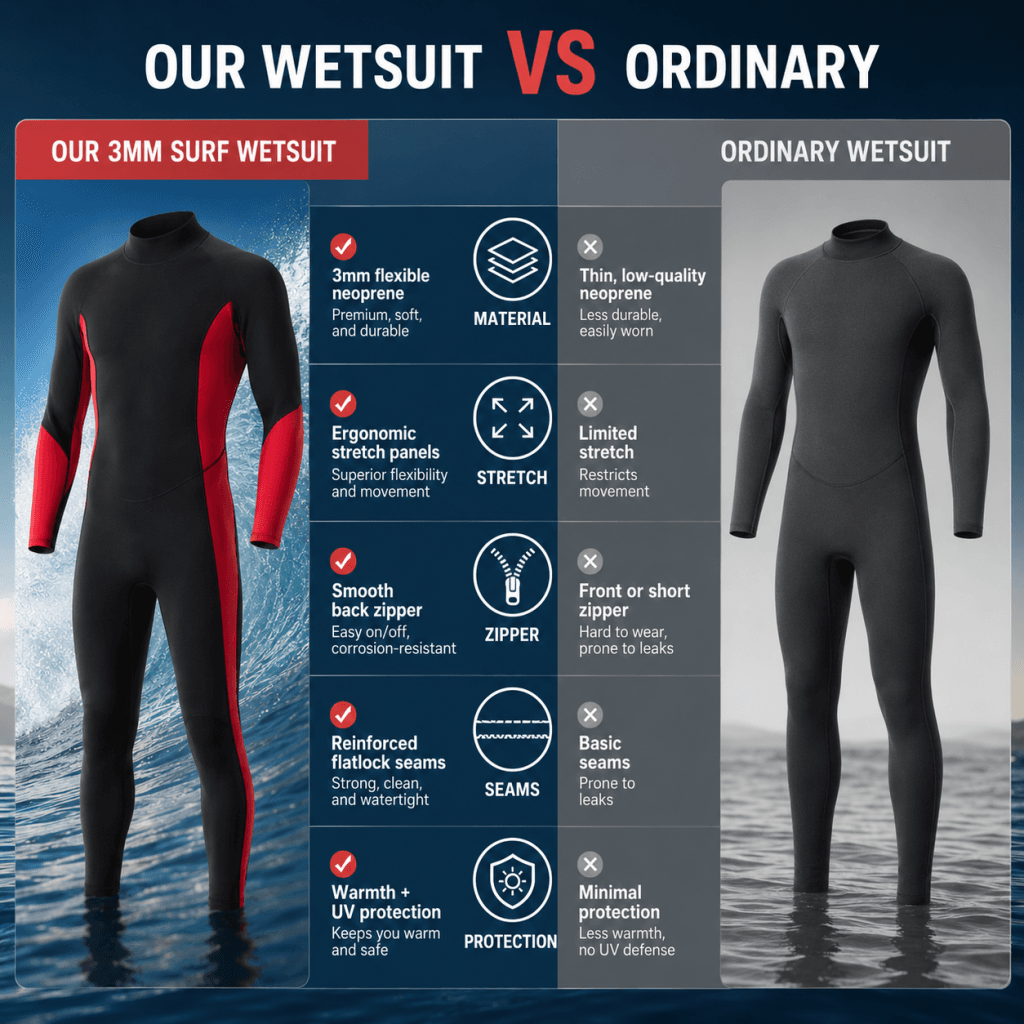
7. Cost Breakdown: Where Does the $400 Actually Go?
Let us follow the money to see how the cost structure differs between a $100 budget wetsuit and a $500 premium one.
$100 Budget Wetsuit — Cost Breakdown
表格
| Line Item | Amount | Share |
|---|---|---|
| Materials (standard petroleum neoprene + basic nylon lining) | $22 | 22% |
| Labor (high-volume factory, flatlock stitching) | $18 | 18% |
| Logistics (ocean freight + warehousing + last-mile) | $12 | 12% |
| Retailer / distributor margin | $25 | 25% |
| Brand operations & marketing | $15 | 15% |
| Factory profit | $8 | 8% |
$500 Premium Wetsuit — Cost Breakdown
表格
| Line Item | Amount | Share |
|---|---|---|
| Materials (limestone neoprene + thermal lining + seam tape) | $110 | 22% |
| Labor (skilled technicians, fully taped/liquid-sealed process) | $75 | 15% |
| R&D (fabric development, fit testing, iteration) | $45 | 9% |
| Logistics (including climate-controlled transport) | $25 | 5% |
| Retailer / distributor margin | $100 | 20% |
| Brand operations & marketing | $80 | 16% |
| Factory profit | $65 | 13% |
Key Takeaways
- The gap from $100 to $300 is almost entirely spent on performance you can feel — better materials, better seams, better zippers. Each upgrade registers the moment you get in the water.
- The gap from $300 to $500 is roughly 40% spent on marginal “best-in-class” gains — from “warm enough” to “luxuriously warm,” from “flexible enough” to “barely there,” from “good” to “flawless.”
- R&D is the hidden moat of the premium tier. Mid-range wetsuits can use off-the-shelf fabric solutions from the supply chain. The thermal linings, liquid-seal formulations, and anatomical fit data in a top-tier suit are the product of years of iterative refinement.
8. Decision Matrix: Which Tier Should You Buy?
表格
| Your Use Case | Budget | Mid-Range | Premium |
|---|---|---|---|
| Tropical vacation — snorkeling or bodyboarding, 3–5 water days per year | ✅ Fine | Not needed | Overkill |
| Summer weekend surfing, 1–2 hr sessions, water above 18°C (64°F) | Workable | ✅ Recommended | Not needed |
| Spring/fall surfing, 2–3 hr sessions, water 14–18°C (57–64°F) | ❌ You will get cold | ✅ Recommended | Optional |
| Year-round surfing including winter, water below 14°C (57°F) | ❌ Not viable | ❌ Marginal | ✅ Required |
| Triathlon racing (speed-focused, low-frequency use) | ❌ | ✅ Recommended | Optional |
| Freediving / scuba diving (deep-water pressure) | ❌ | ✅ Recommended | ✅ Recommended |
| First-time trying surfing, not sure you will stick with it | ✅ Fine | Workable | Overkill |
| Budget is not a concern — you want the best experience | — | — | ✅ |
9. Three Money-Saving Hacks That Actually Work
Hack 1: Buy Last Season’s Premium Model
The wetsuit industry launches new collections each fall. Last season’s stock is often discounted by 40–50%. A $500 premium 4/3mm wetsuit from last year can be picked up during clearance for $280–$320 — the price of a mid-range new-release, but with premium-tier quality.
Best time to buy: September through November, when surf retailers and online shops run clearance sales.
Hack 2: Go Direct-to-Consumer
Some brands skip the traditional retail distribution chain entirely, selling through their own websites and passing the middleman margin back to the buyer. These brands typically have no physical stores and minimal advertising budgets — but they source materials from the same contract manufacturers and employ the same skilled technicians.
The result: $200–$300 gets you $350–$450-level quality. The trade-off is that you cannot try the suit on in person, so you need to measure carefully against their size chart.
Hack 3: Buy Used — But Know What to Look For
A well-maintained premium wetsuit has a typical lifespan of 3–5 years with weekly use. If an owner is selling because the size was wrong, they moved, or they quit the sport — and the suit was properly cared for — you can get it for one-third to half of its original price.
Used wetsuit inspection checklist:
- No seam delamination — gently stretch both sides of each seam; no white thread should be visible.
- Zipper moves smoothly, no grinding or catching.
- Knee and elbow panels show no wear-through or thin spots when held up to light.
- No mildew spots or persistent odor — especially check underarms and crotch.
- Neck seal is intact, not torn or hardened.
- Read the seller’s description for usage frequency and care routine.
10. Frequently Asked Questions
Can I use a $100 wetsuit in winter?
No, and it is not recommended to try. The flatlock stitching on budget wetsuits lets cold water in far faster than you might expect — within 15–20 minutes, you will be shivering. For winter surfing, choose at least a mid-range glued and blindstitched wetsuit. For water below 12°C (54°F), go fully taped or liquid-sealed.
Do expensive wetsuits really last longer?
Yes, but “durability” means different things. A budget wetsuit may hold together physically — nylon panels sewn together are structurally strong — but its insulation performance degrades quickly. A premium wetsuit’s real durability shows in this: after three years of regular use, it still retains roughly 80% of its original warmth and flexibility.
Are there any wetsuits under $200 that rival $400 models?
Yes. Several direct-to-consumer brands offer glued and blindstitched seams, chest-zip entry, and upgraded neoprene in the $200 range — features typically priced at $350 from traditional retail brands. The trade-off is usually fewer size options and fewer color or style choices.
Why do eco-friendly wetsuits cost more?
Natural rubber cultivation and processing is more expensive than large-scale petroleum-based neoprene production. Additionally, environmental certifications such as FSC certification for natural rubber require third-party auditing and compliance costs. The current premium is roughly 15–20%, though this gap is expected to narrow as production volumes increase.
The Bottom Line
The gap between a $100 wetsuit and a $300 wetsuit is something you feel within 10 minutes of getting in the water — warmer, more flexible, less flushing.
The gap between a $300 wetsuit and a $500 wetsuit is something you notice when you put it on three years later and it still feels nearly new.
If this is your first wetsuit: the budget tier is fine. Enjoyment comes first. Gear should never be the barrier to entry.
If you have fallen in love with the water and want to be out there every week: mid-range is your sweet spot. The glued and blindstitched seams plus chest-zip entry turn every session into comfort rather than endurance.
If you live near cold-water coastlines and refuse to miss a good swell all winter: premium is not a luxury. It is a necessity.
Buy what fits your life, not what fits the price tag. The best wetsuit is the one you actually use.
This article is based on industry-standard material science and community feedback. No specific brand product data is cited. Wetsuit performance varies with water temperature, individual cold tolerance, usage frequency, and care habits. Choose according to your personal needs.