Finding a dependable wetsuit manufacturer in China partner is one of the most important decisions for a wetsuit brand. The right supplier affects product performance, production consistency, delivery schedules, margins, and customer satisfaction. For B2B buyers, the lowest quotation is rarely the best starting point. A stronger approach is to evaluate the factory’s technical capabilities, customization options, quality system, communication, and ability to support long-term production.
China has a mature water-sports manufacturing supply chain, which gives international buyers access to a broad range of neoprene materials, production capabilities, accessories, and export services. However, factories differ significantly in experience and specialization. This guide explains how to compare suppliers and how SHANGCHENRUI (SCR) approaches OEM and ODM wetsuit production.
1. Define Your Product Requirements Before Contacting Wetsuit Manufacturer China
A clear product brief makes supplier evaluation faster and quotations more meaningful. Before contacting a potential manufacturer, define the intended use, target market, size range, neoprene thickness, construction, color requirements, logo placement, packaging, estimated order volume, and delivery destination.
For example, a surfing wetsuit may prioritize flexibility and low-bulk construction, while a diving suit for colder water may require greater thermal protection and a different seam configuration. Your manufacturer should be able to explain how material thickness, stretch, panel design, seams, zippers, and finishing affect the final product.
2. Verify That the Supplier Is a Real Wetsuit Manufacturer China
One of the first checks is whether you are dealing directly with a factory or mainly with a trading company. A trading company can still provide useful sourcing services, but direct factory cooperation may give a B2B buyer clearer visibility into production, customization, quality control, and manufacturing costs.
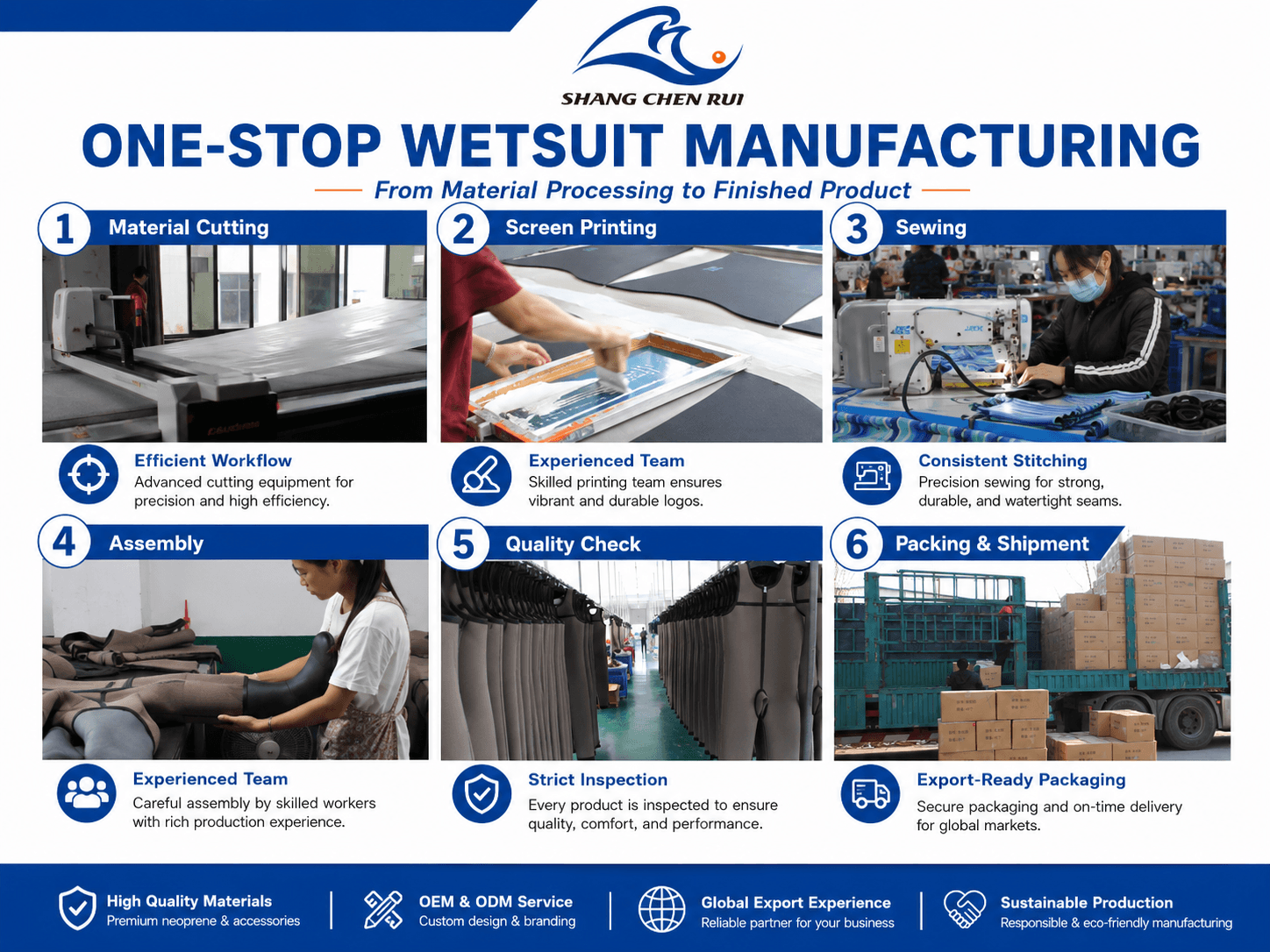
Ask for a factory introduction, production photos or video, manufacturing process information, and evidence that the supplier can handle the specific wetsuit category you need. A credible supplier should be comfortable explaining its production workflow instead of relying only on product catalog images.
3. Evaluate Wetsuit Manufacturer China Neoprene and Material Expertise
Material selection has a direct effect on warmth, flexibility, durability, comfort, and cost. Do not evaluate neoprene only by thickness. Ask about the material grade, stretch characteristics, lamination, lining, surface treatment, and intended application.
A capable wetsuit manufacturer should help you match materials to the target market rather than simply offering the cheapest available option. For a private-label project, it is also useful to request material specifications and samples before approving bulk production.
4. Check OEM, ODM, and Private-Label Capabilities
If you are building your own brand, customization is often more important than a large catalog. Confirm whether the factory can work from your technical drawings or help develop a product from an existing style.
Custom patterns and sizing
Neoprene thickness and material options
Colors and printed graphics
Brand labels and logos
Zipper and seam configurations
Custom packaging and retail presentation
Sample development and revisions
SHANGCHENRUI (SCR) provides OEM and ODM services for diving, surfing, spearfishing, and related water-sports products. Its published manufacturing information describes customization across materials, thickness, patterns, logos, sizing, and packaging.
5. Ask for Samples Before Placing a Bulk Order
A sample is more informative than a quotation sheet. It lets you evaluate fit, stretch, stitching, seam finishing, zipper operation, logo quality, surface appearance, and overall workmanship.
Use a written sample checklist so that every supplier is evaluated against the same criteria. If changes are needed, document them clearly and ask the manufacturer to confirm the revised specifications before production.
6. Examine the Quality-Control Process
A reliable supplier should have quality checks throughout production rather than inspecting only finished products. Ask how raw materials are checked, how workmanship is monitored during production, and how finished units are inspected before packing.
For larger B2B orders, define measurable acceptance standards in advance. These may include dimensions, material thickness, logo position, color consistency, seam quality, packaging requirements, and defect tolerance. Written standards reduce disputes because both sides can evaluate the finished goods against the same specifications.
7. Compare Total Cost, Not Just the Unit Price
The cheapest quotation may become expensive if it leads to inconsistent quality, rework, delays, high defect rates, or complicated communication. Compare the complete sourcing cost, including sampling, tooling or setup charges, packaging, inspection, freight, payment terms, and potential replacement costs.
A professional manufacturer should provide a quotation that is clear enough for you to understand what is included and what may change with different quantities or specifications.
8. Check Production Capacity and Lead Times
Production capacity matters most when demand increases. A supplier that handles a small trial order well may still struggle during peak seasons. Ask about normal sample timing, bulk production lead time, monthly capacity, peak-season planning, and how production schedules are managed.
SHANGCHENRUI states that it supports both smaller trial orders and larger bulk projects, with production covering several water-sports categories. For any order, buyers should confirm the actual schedule in writing rather than relying on a general capacity statement.
9. Pay Attention to Communication and Documentation
Good communication is a practical indicator of manufacturing reliability. The supplier should respond clearly to technical questions, confirm specifications in writing, and identify potential production problems before they become expensive mistakes.
For international orders, keep an organized record of drawings, approved samples, material specifications, color references, packaging artwork, inspection requirements, payment terms, and shipping instructions. This documentation becomes the reference point for repeat orders.
10. Watch for Common Red Flags
The supplier avoids showing meaningful evidence of manufacturing capability.
The quotation is unusually low but specifications are vague.
Sample quality differs significantly from the approved specification.
The supplier cannot explain material or seam construction.
Lead times change repeatedly without a clear production explanation.
The supplier pushes for bulk production before sample approval.
Important product requirements are confirmed only verbally.
Why Consider Wetsuit Manufacturer China?
SHANGCHENRUI (SCR) is a China-based wetsuit manufacturer focused on OEM and ODM production for global water-sports customers. Its published company information highlights more than 26 years of diving-suit manufacturing experience, factory-based production control, customization, and quality inspection throughout the manufacturing process.
For B2B buyers, the practical value is not simply having access to a product catalog. The more important question is whether the manufacturer can turn a product brief into a repeatable production specification. SCR describes support from material selection and pattern development through sampling, production, quality inspection, packaging, and international shipping.
Conclusion
Choosing a reliable wetsuit manufacturer in China should be treated as a structured supplier-evaluation process, not a simple price comparison. Start with a clear product brief, verify manufacturing capability, assess materials and customization, approve samples, define quality standards, compare total costs, and confirm production schedules before placing a large order.
For brands, wholesalers, retailers, and diving businesses, the ideal manufacturing partner is one that can deliver consistent quality while adapting to your market and supporting future product development. SHANGCHENRUI (SCR) offers OEM and ODM wetsuit manufacturing and can be considered as one supplier for buyers looking for a China-based production partner.