Wetsuit Manufacturers vs. Wetsuit Suppliers: What Is the Difference?
Wetsuit manufacturers and wetsuit suppliers can both provide products for your business, but their roles are not always the same. For B2B buyers, understanding the difference can help you choose a partner with the right production capability, customization support, quality control, pricing structure, and communication process.
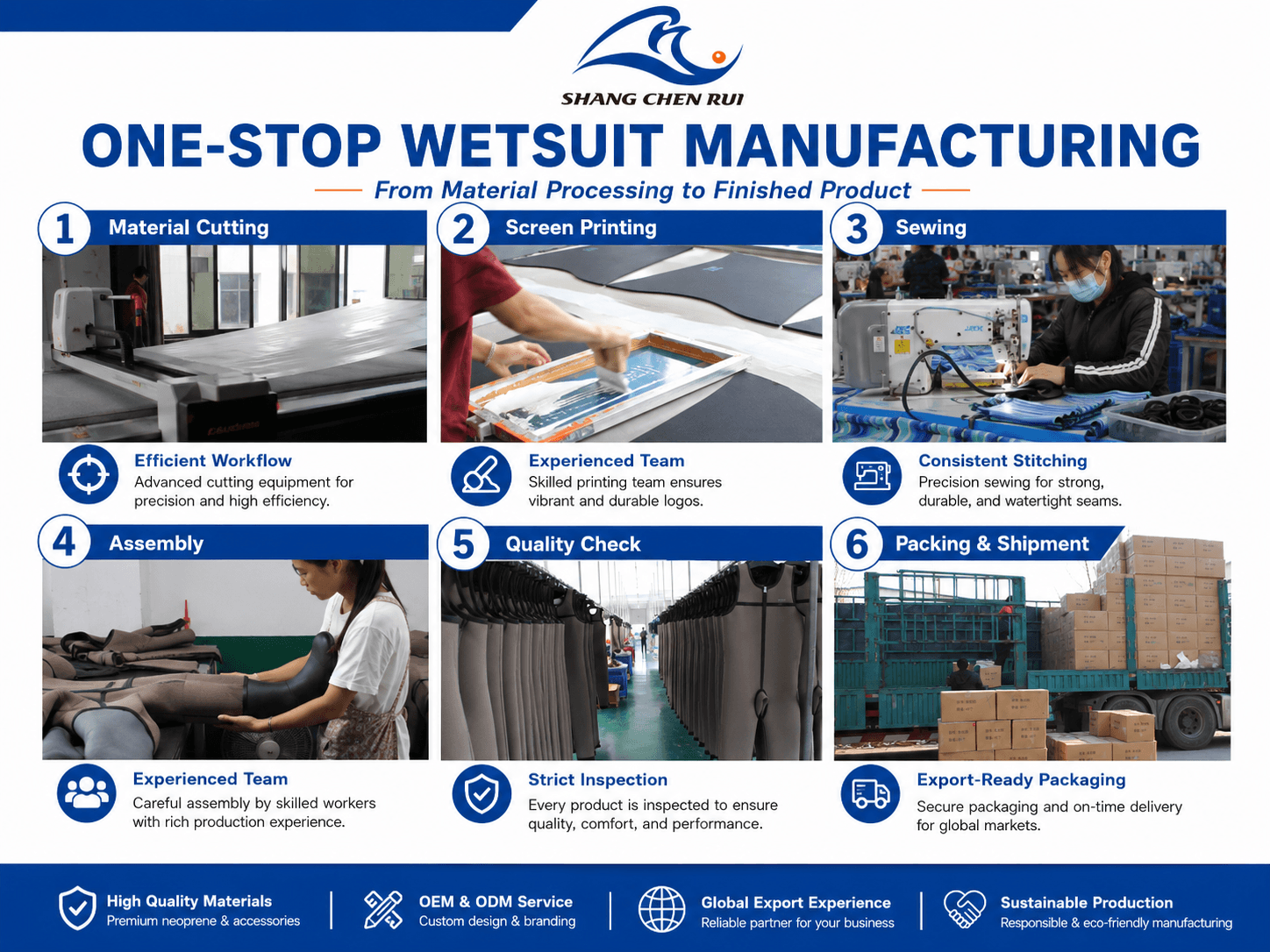
A manufacturer is normally closer to the physical production process. It may manage pattern development, material preparation, cutting, stitching, seam construction, finishing, inspection, and packing. A supplier is a broader term. A supplier may own a factory, operate as a trading company, or coordinate production through one or more third-party factories.
For a brand planning private-label or custom wetsuits, this distinction matters. The right production partner can affect product consistency, development speed, minimum order quantities, lead times, and the ability to scale. This guide explains the practical differences and shows how SHANGCHENRUI (SCR) can fit into a B2B sourcing strategy.
What Are Wetsuit Manufacturers?
Wetsuit manufacturers are companies that directly produce wetsuits or closely control the manufacturing process. Their production resources may include sample-development teams, pattern technicians, sewing operators, cutting equipment, quality-control staff, and dedicated production lines.
A manufacturing company takes technical specifications and turns them into finished products. Specifications can include wetsuit thickness, neoprene characteristics, panel construction, seam type, zipper configuration, size grading, colors, logos, labels, and packaging.
The main advantage is production visibility. When a buyer communicates directly with a factory, technical questions can often be resolved closer to the source. This is useful when a product needs changes after sampling or when a brand wants consistent specifications across repeat orders.
What Is a Wetsuit Supplier?
A wetsuit supplier is any business that supplies wetsuits to a buyer. The supplier may be a factory, but it can also be a sourcing company, trading business, distributor, or other intermediary that purchases products from manufacturers.
A supplier is not automatically a poor choice. A capable supplier can simplify sourcing, combine products from different factories, coordinate shipping, and provide commercial support. The important issue is transparency. Buyers should know who makes the product and who is responsible for quality if the product is outsourced.
Wetsuit Manufacturers vs. Suppliers: Key Differences
| Factor | Manufacturer | Supplier |
| Production control | Usually direct or closely controlled | May be direct or outsourced |
| Customization | Often stronger for technical customization | Depends on factory relationships |
| Quality control | Can be managed at production level | May depend on third-party factories |
| Technical communication | Can be direct with production teams | May involve an intermediary |
| Pricing | May have fewer intermediary layers | May include sourcing or service margin |
| OEM / ODM | Often available if factory has development resources | Depends on manufacturing network |
| Production transparency | Usually easier to verify | Should be confirmed before ordering |
| Scaling | Strong when capacity is stable and documented | Can be flexible with multiple factories |
Why the Difference Matters for B2B Buyers
The distinction becomes more important when the order involves custom specifications. A brand may need a particular fit, thickness, panel layout, seam construction, logo treatment, color standard, packaging format, or private-label program.
In such projects, the buyer needs more than a sales contact. The production partner must understand technical requirements and translate them into repeatable manufacturing steps. Direct communication with wetsuit manufacturers can reduce the risk of misunderstandings between the approved sample and the bulk-production specification.
Customization, OEM, and Private-Label Support
Customization is one of the clearest areas where a factory relationship can add value. In an OEM project, the brand normally provides defined requirements and the factory produces according to those requirements. In an ODM project, the manufacturing team may contribute more design and engineering input.
Common customization options include material selection, thickness, panel layout, colors, graphics, logo placement, zipper type, seam construction, labels, packaging, and size specifications.
However, buyers should not assume that every company calling itself a manufacturer has the same capabilities. Ask for evidence of sample development, production resources, quality procedures, and experience with products similar to yours.
Quality Control at the Factory Level
Wetsuit quality depends on many production details. Material consistency, cutting accuracy, stitching, seam construction, bonding, finishing, size grading, and final inspection can all affect the finished product.
A direct factory can identify production problems close to their source. This can make corrective action faster. An outsourced supplier can also maintain a strong quality system, but the buyer should clarify where inspections take place and who manages corrective action.
For repeat orders, consistency is critical. The production partner should maintain approved specifications across batches instead of treating each order as a completely new project.
Pricing: Is Buying Direct Always Cheaper?
Not necessarily. A factory may offer competitive production pricing, but the total purchasing cost includes more than the unit price. Sampling, development, packaging, inspection, freight, payment terms, and after-sales service can all affect the final cost.
A supplier may charge a margin while providing sourcing, consolidation, logistics, or customer-service value. For this reason, B2B buyers should compare total landed cost and service capability rather than selecting a partner only because the initial quotation is lower.
MOQ, Lead Time, and Production Capacity
Minimum order quantity and lead time vary according to product complexity, materials, customization, and production schedules. There is no universal MOQ for every wetsuit project.
For a new brand, a flexible supplier may help coordinate smaller initial orders. For an established brand, wetsuit manufacturers with stable capacity may provide stronger control over recurring production.
Always ask how sample lead time differs from bulk-production lead time. Confirm whether the production schedule starts after order confirmation, sample approval, material approval, or receipt of the deposit.
How to Verify Wetsuit Manufacturers Before Ordering
Confirm the factory location and basic production information.
Ask which production steps are completed in-house and which are outsourced.
Request samples that match your intended product application.
Ask about available neoprene materials and thickness options.
Review the sample-development and approval process.
Clarify quality-control checkpoints before and during mass production.
Ask how size grading and approved specifications are documented.
Confirm MOQ, sample cost, lead time, payment terms, and packaging requirements.
Request relevant certifications or test reports when your target market requires them.
Ask how defects, rework, replacements, and claims are handled.
When Should You Work with a wetsuit manufacturers?
A direct manufacturer is often a strong choice when you need custom development, private-label production, recurring orders, technical communication, or tighter control over product consistency.
This approach is particularly useful when your competitive advantage depends on differentiated fit, construction, materials, or performance requirements. Direct factory collaboration can become even more valuable as your order volume grows and product specifications become more complex.
When Can a Supplier Be the Better Choice?
A supplier can be practical when you need several product categories, small trial quantities, consolidated sourcing, or help coordinating factories and logistics.
For startups and buyers entering a new market, a capable supplier can reduce supplier-management work. The trade-off is that you should verify who actually manufactures the wetsuits and how quality is controlled.
How SHANGCHENRUI (SCR) Supports B2B Wetsuit Buyers
SHANGCHENRUI (SCR) provides B2B wetsuit manufacturing and supply support for brands, distributors, and water-sports businesses. The focus is on practical production cooperation rather than simply quoting a catalog product.
For buyers comparing wetsuit manufacturers, effective communication is essential. SCR can support discussions around product specifications, customization, branding, order planning, and quality requirements.
For a new product line, buyers should prepare the intended application, target market, preferred thickness, design direction, estimated order quantity, and required delivery schedule. These details help the manufacturing team recommend a realistic production route.
wetsuit manufacturers or Supplier: Which One Should You Choose?
There is no single answer for every B2B buyer. The right choice depends on product complexity, order volume, customization requirements, timeline, and the desired level of production control.
| Your situation | Practical choice |
| You need a highly customized wetsuit | Direct manufacturer |
| You need private-label products | Manufacturer or verified factory-linked supplier |
| You are testing a new market | Flexible supplier or low-MOQ manufacturer |
| You need recurring large-volume production | Direct manufacturer with verified capacity |
| You need multiple product categories | Supplier with a reliable manufacturing network |
| You prioritize production transparency | Direct manufacturer |
Final Checklist Before Placing a Wetsuit Order
Do not evaluate a company by website appearance or unit price alone. Confirm the production relationship, product capability, quality system, customization process, capacity, commercial terms, and communication speed.
A reliable sourcing decision should answer five questions: Who makes the product? Can the factory reproduce the approved specification? How is quality checked? Can the partner meet your expected volume and schedule? Who is responsible if the product does not meet the agreed standard?approach is consistent with Google Search Central guidance on people-first content and avoiding keyword stuffing.
Conclusion
The main difference between wetsuit manufacturers and wetsuit suppliers is the level of direct involvement in production. A manufacturer generally provides closer access to factory processes, while a supplier may provide broader sourcing and coordination services.
For brands that need custom products, private labeling, consistent quality, and long-term production, working directly with capable wetsuit manufacturers can offer stronger control. For buyers who value flexible sourcing or multiple product categories, a well-managed supplier can also be a good fit.
The best B2B partner is not simply the company with the lowest quotation. It is the partner that can consistently deliver the right product at the required quality, quantity, and timing. SHANGCHENRUI (SCR) aims to support buyers with a manufacturing-focused approach and practical communication throughout the sourcing process.