The Wetsuit Manufacturer You Choose Can Shape Your Brand
For a watersports brand, choosing a wetsuit manufacturer is more than finding a factory that can produce a garment at a competitive price.
The right manufacturing partner affects almost every part of your product strategy:
- Material quality influences comfort and durability
- Pattern development affects fit
- Production consistency affects customer reviews
- Minimum order quantities influence inventory risk
- Lead times can determine whether you launch on schedule
For this reason, brands should evaluate manufacturers from a long‑term business perspective rather than comparing unit prices alone.
A reliable partner should be able to understand your product requirements, communicate clearly, maintain consistent quality, and scale with your business.
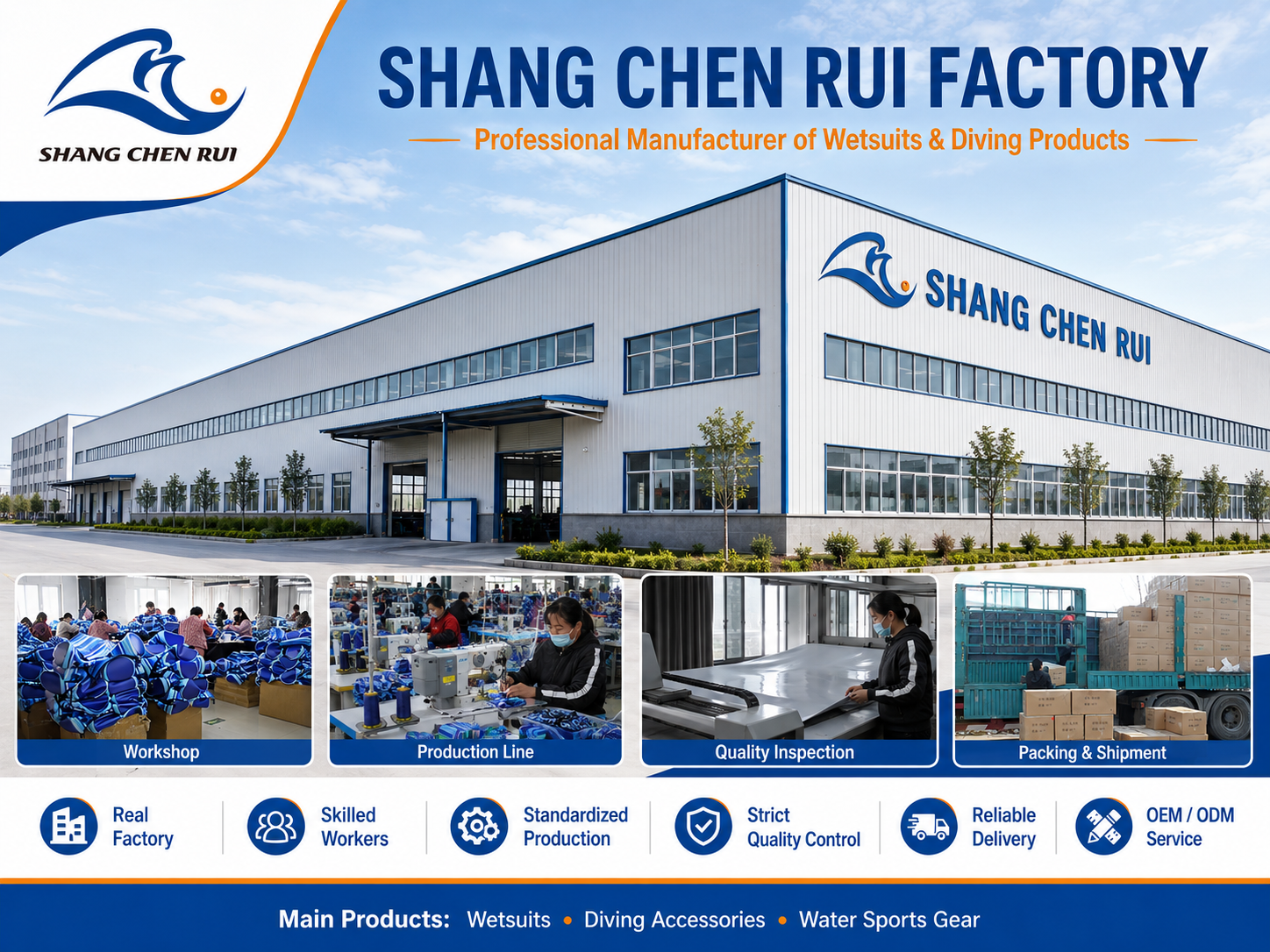
This guide breaks down the key factors brands should consider when selecting a wetsuit manufacturer and shows how SHANGCHENRUI (SCR) approaches B2B wetsuit production.
1. Start With Your Brand’s Product Requirements
Before contacting manufacturers, clearly define what you actually need.
Different watersports applications require different wetsuit designs. A surfing brand may prioritize flexibility and streamlined construction, while a diving brand may focus heavily on thermal insulation, durability, and protection.
Build your product brief covering these points:
✅ Intended watersport or application
✅ Target market and climate
✅ Wetsuit thickness
✅ Material requirements
✅ Product type and construction
✅ Size range
✅ Color requirements
✅ Logo and branding
✅ Packaging
✅ Expected order quantity
✅ Target price range
✅ Required certifications or testing
✅ Expected delivery schedule
💡 A clear specification allows manufacturers to provide more accurate quotations and makes side‑by‑side supplier comparisons far easier.
Why This Step Matters
Two factories may quote different prices for what appears to be the same wetsuit. However, the underlying specifications may not be identical.
Differences in neoprene quality, lining, zipper systems, stitching, seam sealing, printing, accessories, packaging, and quality‑control standards can significantly change final product costs.
Always compare equivalent specifications — not just quoted unit prices.
2. Evaluate the Wetsuit Manufacturer’s Material Expertise
Material selection is one of the most critical factors when choosing a wetsuit supplier.
Traditional wetsuits commonly use neoprene for its balanced flexibility, insulation, buoyancy, and durability. However, neoprene comes in many different grades and constructions.
The raw material is only half the story. Your manufacturer must also understand how materials perform during cutting, lamination, sewing, bonding, and finishing.
Key Material Questions to Ask Your Supplier
- Neoprene type and grade
- Material thickness
- Stretch performance
- Thermal insulation
- Lamination construction
- Fabric lining
- Surface treatment
- Material durability‑ Eco‑friendly or alternative material options
Your manufacturer should recommend materials based on your end‑use scenario, not only offer the cheapest available option.
Example: A premium cold‑water wetsuit needs completely different material specs compared with a lightweight warm‑water model.
3. Check Customization and Product Development Capabilities
For most established brands, off‑the‑shelf wetsuits are rarely sufficient. Brand differentiation often comes from fit, materials, colors, construction, logos and functional details.
A capable custom wetsuit manufacturer should support the full product‑development workflow:
- Pattern development
- Size grading
- Material selection
- Color matching
- Logo application
- Printing
- Label customization
- Zipper selection
- Seam construction
- Packaging design
- Prototype development
- Pre‑production samples
Order Samples Before Large‑Batch Production
Samples are one of the best ways to test a manufacturer’s real‑world capabilities.
Don’t only judge appearance. Inspect:
Fit, stretch, stitching, seam quality, glue/bonding consistency, zipper function, logo placement, material feel, size accuracy, and overall finishing.
Professional manufacturers maintain formal workflows for sample confirmation and pre‑production approval.
4. Examine Wetsuit Manufacturer Quality Control at Every Production Stage
Quality control should not start after wetsuits are finished — it must be built into the whole manufacturing workflow.
A trustworthy wetsuit factory runs inspections across raw materials, cutting, assembly, seam work, finishing, and final packing.
Practical End‑to‑End QC Workflow
Raw Material Inspection → Cutting Inspection → Sewing/Assembly Inspection → Seam Inspection → Finished Product Inspection → Packing Inspection
Catching defects early avoids costly downstream issues:
- Wrong‑cut patterns create fit problems that final inspection cannot fully fix‑ Poor‑quality seam work causes durability failures after customer use
For brands, batch‑to‑batch consistency is non‑negotiable; customers expect the same quality every time they buy your product.
5. Compare Wetsuit Manufacturer Production Capacity and Scalability
A factory may deliver perfect samples yet fail when your order volume grows. Evaluate production capacity before locking in a long‑term partnership.
Ask potential suppliers:
- What is your monthly production capacity?
- What is your typical lead time?
- How many production lines do you operate?
- Can you handle seasonal demand spikes?
- How will you manage significantly larger order volumes?‑ How do you process urgent production requests?‑ Are core production steps completed in‑house, or outsourced?
Why Scalability Matters
Imagine your first order is 500 units, completed smoothly. Six months later you need 5,000 units for a new season.
If the factory cannot scale without sacrificing quality or extending lead times, your brand’s growth becomes a supply‑chain headache.
A solid manufacturing partner owns the infrastructure and production management systems to support you from small initial runs to high‑volume orders.
6. Understand Wetsuit Manufacturer MOQ and Its Impact on Inventory
Minimum Order Quantity (MOQ) directly shapes your inventory risk.
High MOQs can lower per‑unit costs, yet create heavy inventory pressure for emerging brands.
Lower‑MOQ solutions bring flexibility for:
- New product launches
- Market testing
- Seasonal collections
- New colors / new sizes
- Small brand campaigns‑ Product validation
When speaking to manufacturers, clarify exactly how MOQ applies:
Is MOQ calculated per full order, or per model, per color, per size, per material, or for custom packaging?
These details heavily impact your real purchasing costs.
7. Don’t Choose a Manufacturer Based on Price Alone
Price matters, but the lowest quote is not always the lowest total cost.
Cheap unit pricing can turn expensive if it brings high defect rates, inconsistent sizing, shipment delays, material failures, rework work, excess inventory, customer complaints, or product returns.
Focus on total value, evaluating together:
Material quality, build quality, MOQ, lead time, customization options, production capacity, communication, QC standards, packaging, and after‑sales support.
Your ideal supplier strikes a practical balance between cost, quality, flexibility and service.
8. Verify Certifications and Compliance Requirements
International brands must respect regional regulatory and market rules.
Depending on your target market and product use‑case, you may need specific testing, documentation, labeling, and compliance procedures.
Don’t just ask “are you certified?” Request documentation relevant to your exact product and target market:
- Applicable product certifications‑ Material specification documents‑ Independent test reports‑ Internal quality‑control records‑ Factory audit information‑ Full product specifications‑ Market‑specific compliance paperwork
Confirm that documents apply to the exact wetsuit you will purchase, not generic reference products.
9. Assess Communication and B2B Service
Manufacturing is communication‑heavy work. Even an outstanding factory becomes hard to work with if replies are slow or unclear.
Before placing large orders, observe how they handle your initial inquiry. Evaluate:
- Response speed‑ Technical product understanding‑ Clarity of quotations‑ Sample‑cycle communication‑ Production‑update transparency‑ Ability to answer detailed technical questions‑ Willingness to flag potential manufacturing risks‑ Ability to propose practical improvements
A good manufacturer will not blindly approve every request. The best partners will flag designs that risk production issues and propose better alternatives.
10. Look for a Manufacturer That Supports Your Brand, Not Just Your Order
Transactional suppliers focus only on finishing individual orders.
A strategic manufacturing partner thinks long‑term about your product and brand.
A long‑term partner can help you:
‑ Optimize product specifications
‑ Improve manufacturing efficiency
‑ Develop new product models
‑ Cut unnecessary material costs
‑ Stabilize batch‑to‑batch production quality
‑ Plan seasonal order cycles
‑ Expand your product portfolio
‑ Manage repeat production runs
This collaborative value grows as your brand scales.
11. Why Choose SHANGCHENRUI (SCR)?
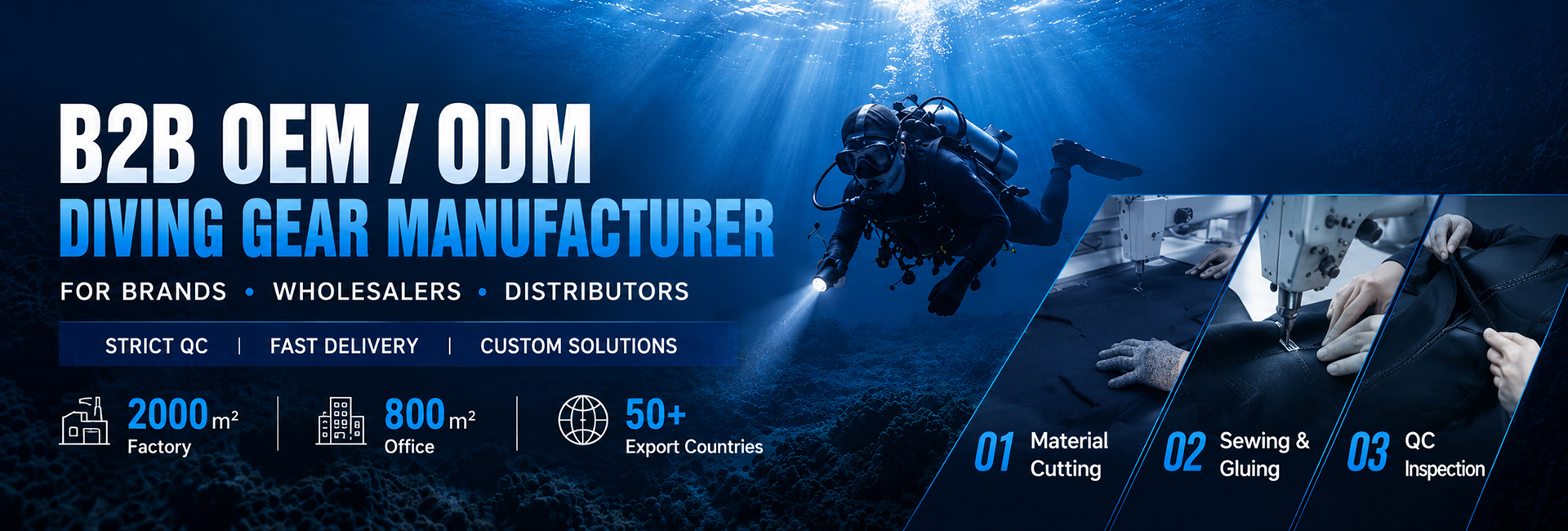
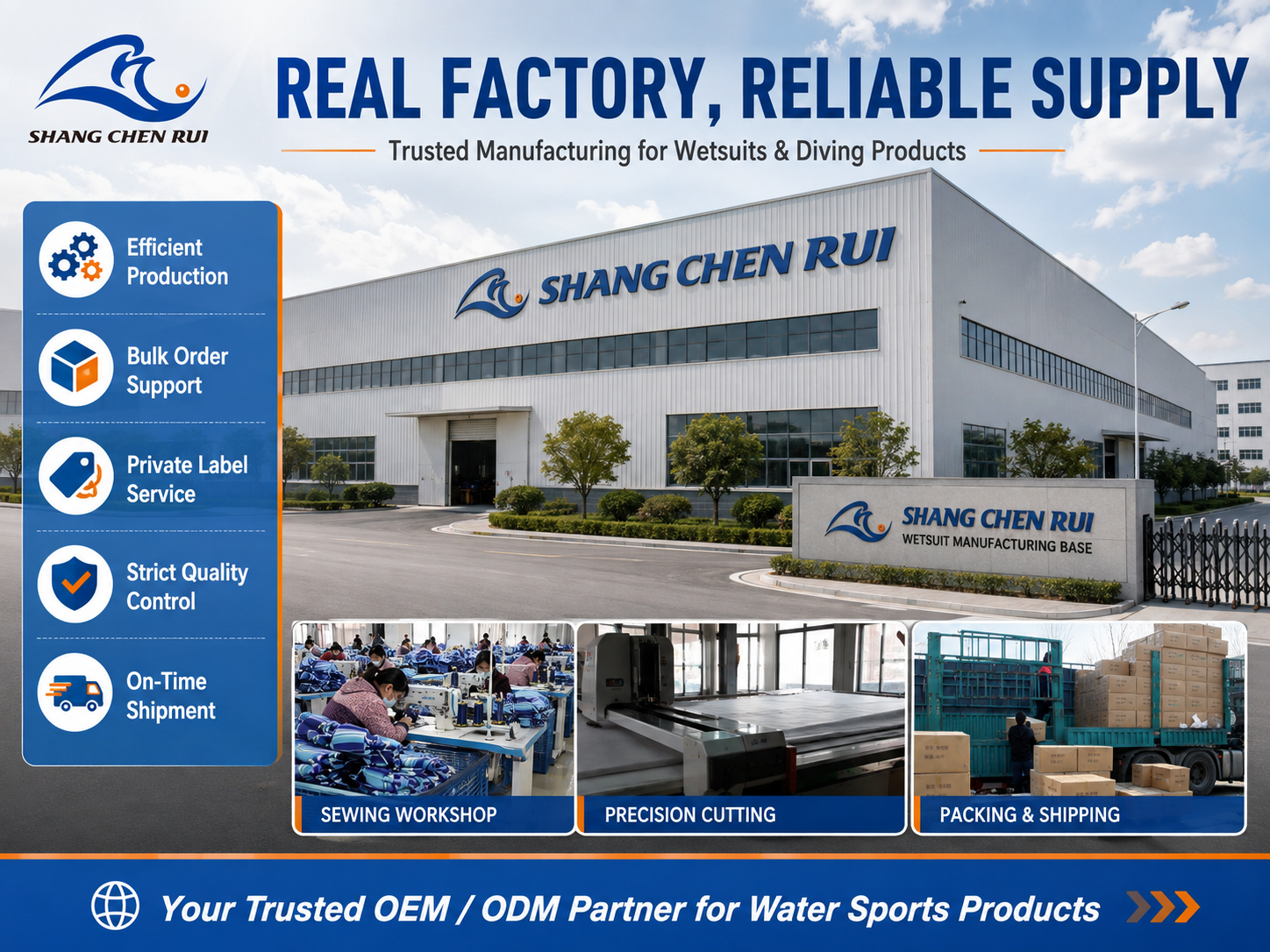
SHANGCHENRUI (SCR) acts as a dedicated B2B wetsuit manufacturing partner for brands, distributors, retailers and businesses seeking custom wetsuit solutions. We combine strong manufacturing capability with flexible business support.
✅ Custom Product Development
SCR works from your brand‑level requirements for specs, materials, colors, branding and custom details. We turn your product concept into production‑ready specifications.
✅ Flexible Order Support
Brands have different purchasing volumes. SCR delivers flexible B2B order solutions for early‑stage brands as well as large‑volume buying programs.
✅ Consistent Production
For growing brands, batch consistency is as critical as the first sample. SCR emphasizes production control and multi‑stage inspection to preserve consistent specs across production runs.
✅ Responsive B2B Communication
Product development often requires multiple specification revisions, sample iterations and approvals. Clear communication cuts delays and prevents misunderstandings before mass production starts.
SCR supports customers end‑to‑end: initial requirements & quotation → sample development → manufacturing → after‑sales support.
12. Questions to Ask Before Choosing a Wetsuit Manufacturer
Use this checklist during supplier outreach. Manufacturers who answer clearly are far easier to evaluate than those who only send basic price lists.
Product Capability
- What types of wetsuits do you manufacture?
- What materials and thickness options are available?
- Can you develop fully custom patterns?
- Can you produce private‑label wetsuit products?
- Do you support custom colors and custom logos?
Manufacturing
- What is your monthly production capacity?
- What are your standard lead times?
- What is your MOQ policy?
- Can your production scale for larger future orders?
- Which production processes are completed in‑house?
Quality
- How do you inspect incoming raw materials?
- What does your finished‑product inspection process look like?
- What quality standards do you follow?
- Can you provide relevant test reports and certifications?
- How do you handle defective‑product scenarios?
Business Cooperation
- Can you supply pre‑mass‑production samples?
- How do you manage sample revisions?
- What details do you need from me for an accurate quotation?
- How will you share production‑progress updates?
- What after‑sales support do you offer?
13. Red Flags to Watch for When Choosing a Supplier
Not all manufacturers fit long‑term brand partnerships. Proceed cautiously if you see multiple of these warning signs:
⚠️ Avoids detailed technical product questions
⚠️ Cannot explain material specifications clearly
⚠️ Refuses to provide product samples
⚠️ Delivers inconsistent or changing quotations
⚠️ Cannot describe their quality‑control workflow
⚠️ Makes unrealistic delivery‑time promises
⚠️ Changes product specifications without your written approval
⚠️ Provides vague or unverifiable certification documents
⚠️ Extremely low pricing without clear justification
⚠️ Poor responsiveness after receiving payment
Note: One single warning sign does not automatically mean a supplier is unreliable. Multiple overlapping red flags warrant deeper verification.
14. A Simple Supplier Evaluation Framework
Avoid relying purely on intuition. Use a weighted scoring system to compare factories objectively. Score each manufacturer from 1‑5 for each category.
表格
| Evaluation Category | Suggested Weight |
|---|---|
| Product Quality | 25% |
| Customization Capability | 15% |
| Production Capacity | 15% |
| Price Competitiveness | 15% |
| MOQ Flexibility | 10% |
| Lead Time | 10% |
| Communication & Service | 10% |
This method prevents price from becoming your only decision driver.
15. The Right Manufacturer Is a Long‑Term Business Decision
Selecting a wetsuit manufacturer is far more than a simple purchasing task.
Your chosen factory impacts product quality, customer satisfaction, inventory management, launch timelines and overall brand reputation.
The best supplier is not always the largest factory or the cheapest option.
It is the manufacturer that can consistently deliver your required quality, communicate transparently, respect your product requirements, and grow alongside your business.
If you are sourcing a reliable manufacturing partner, SHANGCHENRUI (SCR) delivers B2B wetsuit manufacturing and customisation built for diverse product and purchasing needs.
📩 Looking for a wetsuit manufacturer for your next collection?
Share your product specifications, target quantity, preferred materials and customisation requirements with the SCR team. We will assess your project and deliver a tailored manufacturing solution.
Frequently Asked Questions
Q: What should I look for in a wetsuit manufacturer?
A: Evaluate material quality, manufacturing capability, customisation options, MOQ, production capacity, quality control, lead times, certifications, communication, and after‑sales service.
Q: How do I compare two wetsuit manufacturers?
A: Compare them using identical product specifications. Judge quality, materials, customisation, MOQ, price, lead time, production capacity and service — never compare unit price alone.
Q: Can a wetsuit manufacturer produce private‑label products?
A: Many factories offer private‑label production. Confirm they can deliver custom logos, labels, packaging, colours, patterns and full‑product specification adjustments.
Q: What is the typical MOQ for custom wetsuits?
A: MOQ differs by manufacturer, design, material, colour and customisation. Always request MOQ figures for your exact product, rather than relying on generic estimates.
Q: Why is sample approval important?
A: Samples let your brand verify fit, materials, construction, branding, sizing and finishing before mass‑production. This greatly reduces costly production‑risk exposure.
Q: Is the cheapest wetsuit manufacturer the best choice?
A: Not necessarily. Low unit pricing can come with higher defect rates, inconsistent quality, extended lead‑times or limited customisation. Always evaluate total value, not only price.
Final Takeaway
To select the best wetsuit manufacturer, look well beyond quotations.
- Define your product requirements first
- Evaluate material expertise and custom‑development capabilities
- Audit quality‑control procedures and production capacity
- Compare MOQ rules and lead‑time commitments
- Validate relevant compliance documentation
- Assess communication quality and long‑term service potential
For B2B brands, your ideal manufacturer is more than a production facility.
It is a partner who turns your product specifications into consistent, commercially viable wetsuits.
SHANGCHENRUI (SCR) aims to deliver this combination of manufacturing strength, customisation flexibility, strict quality control and dedicated B2B support for global brands.